Autonomous World
From now on, we will refer to each application built with Mud as an autonomous world. Essentially, an autonomous world is a series of smart contracts organized under core storage protocol and resource usage and management protocol, forming a structured whole through various forms of contract interactions.
Understanding the composition and operation of autonomous worlds is key to flexibly using the Mud framework.
Components
In the Mud Framework Introduction, we mentioned that Mud, like Diamond, separates data from business logic.
For ease of understanding, let’s assume we’re implementing a standard ERC20
token project. With data and business logic separated, ERC20 Metadata,
balances, and allowances are stored in one contract, while
methods like transfer and approve are implemented in other
contracts.
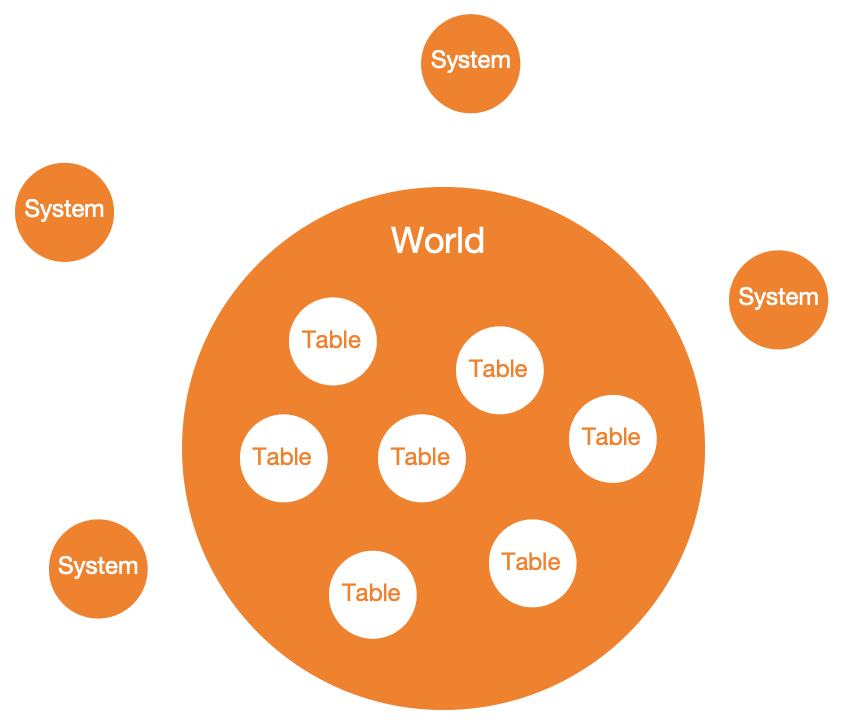
The above image vividly represents the composition of a basic autonomous world
built with Mud. Each orange circle represents a contract instance. The largest
one in the center is the main contract of the autonomous world, World,
which contains all data storage implemented with Table. Surrounding the
main contract are System contracts carrying business logic. Their role
is to guide the main contract on how to operate its internal data in different
interaction scenarios, but they don’t store any data themselves.
The data-storing World together with all the surrounding data-less
System contracts collectively form a simple autonomous world instance.
For our ERC20 token project, one possible implementation could involve 2
contracts, 3 tables, and 1 system. The 2 contracts are World and
ERC20System. The 3 tables are ERC20Metadata, Balances,
and Allowances, all stored within the World contract. The 1
system is ERC20System, containing all IERC20 interface implementations.
Operation Mechanism
When the balances data and transfer function of an ERC20 token are
located in two different contracts, World and ERC20System respectively,
the most common method to ensure the transfer can correctly modify balances is:
--> call, ==> delegatecall

EOA/Contracts --> World ==> ERC20System
Use
Worldas the token’s address, meaning it’s the entry point for all IERC20 method interactions.Add a fallback for the
IERC20.transferfunction toWorld.In the
IERC20.transfer fallbackimplementation, call theERC20System.transfercontract functino usingdelegatecall, directly modifyingbalances.
This is also the basic principle of various proxy contracts and Diamond.
Besides this, we have a simpler method using the most basic inter-contract
interaction call instead of delegatecall.
EOA/Contracts --> World --> ERC20System --> msg.sender: World
                                 └--------> msg.sender: World
Use
Worldas the token’s address, meaning it’s the entry point for all IERC20 method interactions.Record in the
Worldcontract thataddress(ERC20System)has access to update theBalancestable.Add a fallback for the
IERC20.transferfunction toWorld.In the
IERC20.transfer fallbackimplementation, call theERC20System.transfercontract function usingcall.ERC20Systemcallsmsg.sender: Worldusingcallto query theBalancestable, obtaining balance information for the sender and receiver.Calculate the new balance information for both addresses after the transfer,
ERC20Systemcallsmsg.sender: Worldusingcallto update theBalancestable.
Note
ERC20System must know where to query and update the Balances table.
Using the inter-contract call relationship to get the World address via
msg.sender is one method.
Recording the World contract address within the ERC20System contract is
another method, but this violates the principle of separating data from business
logic, compromising the reusability of logic contracts.
Note
The latter, compared to the former, can introduce access control. World
can judge whether there’s access to update specific tables based on
msg.sender.
The former, not departing from the World context, can modify all its own
slots, meaning it has write access to all tables, and cannot be
restricted at the contract level.
The common point of both methods is that World serves as the unified entry
point for the autonomous world. Even if we want to introduce more complex
logic in the future, such as adding staking and earning functionality to our
ERC20 token project, it would still involve creating more tables in the same
World, deploying more systems, and establishing interactions with World
using either of the above methods. We will still have only one interaction
entry point, which is the World contract.
The difference between the two methods is only reflected in how World
interacts with System. The resulting impact is that the former can not only
modify the Balances table but also the Allowances table and even all
other tables. The latter can only modify the Balances table and only allows
addresses with access to make modifications. Each has its advantages and
disadvantages; the former is more convenient, while the latter is more secure.
Mud supports both of these methods simultaneously. In an autonomous world,
World can interact with some System using the first method while
interacting with others using the second method. The choice of interaction
method depends entirely on the namespace of the System. The
namespace is precisely the foundation for Mud’s implementation of
access control.
Note
When a system belongs to a custom namespace, the World contract interacts
with the system contract via call. When a system belongs to the root
namespace, the World contract interacts via delegatecall.
Developers can flexibly choose namespaces based on their needs.
Access Control
Imagine our ERC20 token project achieves tremendous success, and we decide to add common DeFi features like staking, mining, and voting. Each feature’s implementation will inevitably introduce new tables and systems. As the number of tables and systems increases, we urgently need a management protocol that allows each system to update the tables they need, while restricting them to only those tables. For example, the staking system should be able to update all staking-related tables, such as staking status and rewards, but cannot update voting-related tables, like voting weights.
This sounds simple, like being a company boss assigning employees to different departments based on their roles. In the office system, you’d allocate different file access and system access based on employee IDs or their departments.
This is exactly what Mud does:
Both
SystemandTableare called resources, each assigned a uniqueResourceIdidentifier.Establish a resource hierarchy, using higher-level namespaces as superior resources for system and table resources.
Control resource access at the namespace level.
Resource identification is the first step in effective resource management.
ResourceId is a bytes32 data type, concatenated from three fixed-length
string byte arrays. The first string, length 2, indicates resource type:
on-chain table tb, off-chain table ot, system sy, namespace ns.
The second string, length 14, represents the namespace name. The third
string, length 16, denotes the resource name.
Note
When the resource type is ns, the resource name is an empty string.
Resource hierarchies enable multi-dimensional access control. A namespace is a collection of system and table resources, also a high-level resource.
As such, an ERC20 token project with added staking and voting functions might look like this in an autonomous world.
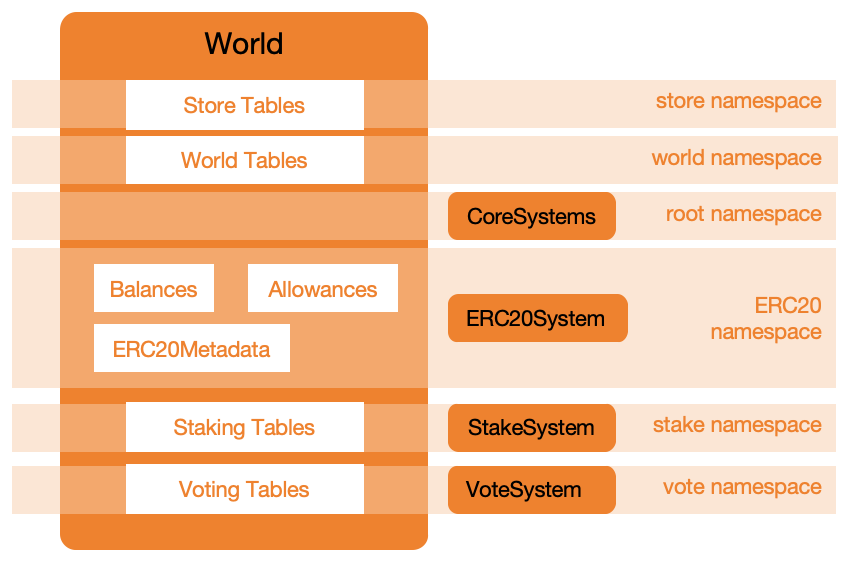
The 3 tables and 1 system required to implement IERC20 are grouped under
the ERC20 namespace.
The tables and systems needed for staking mining functionality are
grouped under the Stake namespace.
The tables and systems required for voting functionality are grouped
under the Vote namespace.
In this way, ERC20System can only update tables under the ERC20
namespace,
StakeSystem can only update Staking Tables,
VoteSystem can only update Voting Tables.
However, don’t worry about data barriers; systems can’t update tables in
other namespaces, but read-only access is still possible.
This is because all tables are completely open and transparent.
Note
In an autonomous world, developers commonly use two namespaces: root and
custom namespaces. The root namespace has default core systems like
AccessManagementSystem, providing basic functionalities such as
access configuration.
Note
Each autonomous world has two special namespaces: store and world,
representing the Store protocol and World protocol. These are core
protocols maintaining the autonomous world’s operation. One handles
low-level data storage implementation, while the other manages high-level
resource usage and management, including resource registration and access
control.